How Google, Broadcom, Apollo, Blackstone and a handful of crypto miners built one of the largest infrastructure financing programs on record — and what breaks if Anthropic’s growth slows.
Notes on public deal reporting · Sources: Financial Times, Bloomberg, Benzinga, TradingKey
A financing problem with no obvious lender
Anthropic wants an enormous amount of AI compute. Google wants to sell it. Neither of those facts is unusual in 2026. What is unusual is the plumbing connecting them: a roughly $200 billion web of contracts running through Broadcom, Apollo, Blackstone, Morgan Stanley, and a group of crypto-mining companies turned power suppliers — all of it built around a single, structural fact.
Anthropic does not have a credit rating. No bank or bond investor can underwrite a loan to a private company with no ratings history the normal way. So instead of lending to Anthropic directly, the deal’s architects built a structure that lends against the chips themselves, with enough credit enhancement layered on top to make the debt investment-grade regardless of Anthropic’s own standing.
How the structure works
The mechanism has six moving parts. Strip away the financial engineering and it comes down to: buy chips with borrowed money, lease them to Anthropic, and use the lease payments to repay the debt — with guarantees at nearly every step to make that debt palatable to conservative investors.
- Google designs TPUs (in partnership with Broadcom since 2016) and sells the hardware — an April agreement alone covered 3.5 gigawatts of TPU capacity.
- Broadcom takes the hardware and resells it onward, while also standing behind a chunk of the financing with a residual value guarantee.
- A special purpose vehicle, Compute SPV, buys the chips outright — its first purchase was about one gigawatt (roughly one million TPUs) for $35 billion in June.
- Apollo and Blackstone arranged that $35 billion as private credit, split into three tranches: a $6 billion Senior A1, a $24 billion A2, and a smaller equity slice from Apollo’s Atlas SP Partners.
- Broadcom’s guarantee covers about $30 billion of that debt — if Anthropic stops paying, Broadcom compensates the A1 and A2 tranche holders in full before they take a loss.
- Crypto-mining companies, which had already secured large blocks of electricity capacity, supply the power and data center space needed to actually run the chips.
Compute SPV then leases the hardware to Anthropic. Anthropic’s lease payments are what repay the SPV’s debt — which means the entire structure’s credit quality ultimately rests on Anthropic’s ability to keep paying, even though the guarantees are what got the debt an investment-grade rating in the first place.
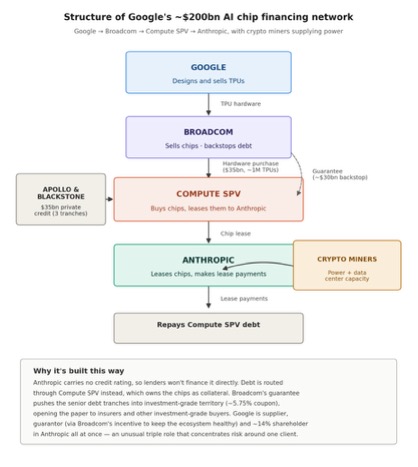
Structure of the Google–Broadcom–Compute SPV–Anthropic financing network
Why it’s built this way
The guarantee is the entire trick. Broadcom’s backstop on the senior tranches pushed that paper’s effective credit quality close to Broadcom’s own investment-grade rating — which is what let the debt price at around 5.75%, a rate only achievable because insurers and other conservative, investment-grade-only buyers could participate. Without the guarantee, this would have been a much smaller, much more expensive junk-rated raise, if it could be done at all.
The other notable feature is Google’s position. Alphabet owns roughly 14% of Anthropic, which makes Google simultaneously the chip supplier, an indirect guarantor of the financing (through its partnership with Broadcom), and a shareholder betting on Anthropic’s equity value — an unusually concentrated set of roles for one company to hold in a single counterparty’s success.
This is also explicitly a template. Broadcom’s CEO has described the arrangement as an “AI XPV Platform” built with Apollo and Blackstone, targeting more than 20 gigawatts of deployed compute by 2028. Blackstone has already floated a second package, potentially $36 billion or more, timed around Anthropic’s confidential US IPO filing. The mechanism used here — hardware held off-balance-sheet in an SPV, repaid through lease income — is reportedly already being adapted for other AI infrastructure deals across the industry.
What happens if Anthropic’s growth slows
The structure is explicitly designed to survive a payment shortfall on paper. If Anthropic misses lease payments, Compute SPV sells the chips as collateral; if the sale proceeds fall short, Broadcom covers the difference on the senior tranches. That’s the mechanical answer. But a slowdown radiates well past that first-order fix.
The direct financial hits
- Google’s equity stake reprices down — a roughly 14% position in a company whose growth trajectory just broke.
- Google sells fewer TPUs going forward, since Anthropic was the anchor demand behind a large share of the pipeline — Broadcom’s own filings tie nearly all of its $128 billion in purchase commitments through 2028 to Google TPUs.
- Broadcom’s balance sheet absorbs the guarantee payout on the senior tranches, which could make it more conservative about backing future TPU-linked financing — tightening the very mechanism Google needs for other customers.
The slower, harder-to-unwind damage
- Stranded infrastructure: power contracts and data center capacity built for this specific deployment don’t disappear when demand softens — Google and the crypto miners still carry that capex and those commitments.
- Reference-customer credibility: Anthropic is Google’s proof that TPUs can carry a frontier lab’s workload at scale, competing directly with Nvidia. A visible stumble here undercuts that pitch to every other prospective TPU customer, not just Anthropic.
- Template contagion: since this SPV-and-lease structure is already being copied for other deals, a stress event here raises the cost of capital for every subsequent transaction using the same template — including future ones Google is counting on.
- Regulatory and reputational scrutiny: Google’s simultaneous role as supplier, guarantor, and shareholder has already been flagged by market observers as an unusual concentration of risk. A default event that crystallizes losses across Apollo- and Blackstone-held tranches invites the kind of “circular financing” scrutiny that has already dogged similar AI-industry financing arrangements elsewhere.
The bottom line
The guarantees in this structure solve a credit problem, not a demand problem. They make the debt investment-grade on paper, but every layer of protection — the SPV’s collateral, Broadcom’s backstop, the lease income repaying the debt — is ultimately funded by Anthropic’s revenue growth continuing roughly as projected. That is the trade the market is making at $200 billion of scale: financial engineering that distributes risk across more balance sheets, wrapped around a single underlying bet that hasn’t gone away.